Context
Before the operations
A slope settled by need
See the toursGuides
Language
Currency
View availabilityfrom $21 · no cancel feeGroup price check
Answer in brief
Comuna 13 Medellin history runs from a hillside settled by migration through the 2002 military operations to the art and public works of today.
The story in brief
Compare 3 alternatives
Set your group size and weigh walks that leave room for history.
≈
View≈
View≈
ViewCurrency conversion uses the ECB reference rate on GetYourGuide from-prices. The exact price is displayed when you book.
What Comuna 13 is, what official memory sources say about the years of armed conflict, how residents answered with art and hip hop, and how to visit with respect.
Editorial team, comuna13tour.click · Updated November 24, 2026 · Takes 8 min
Overview
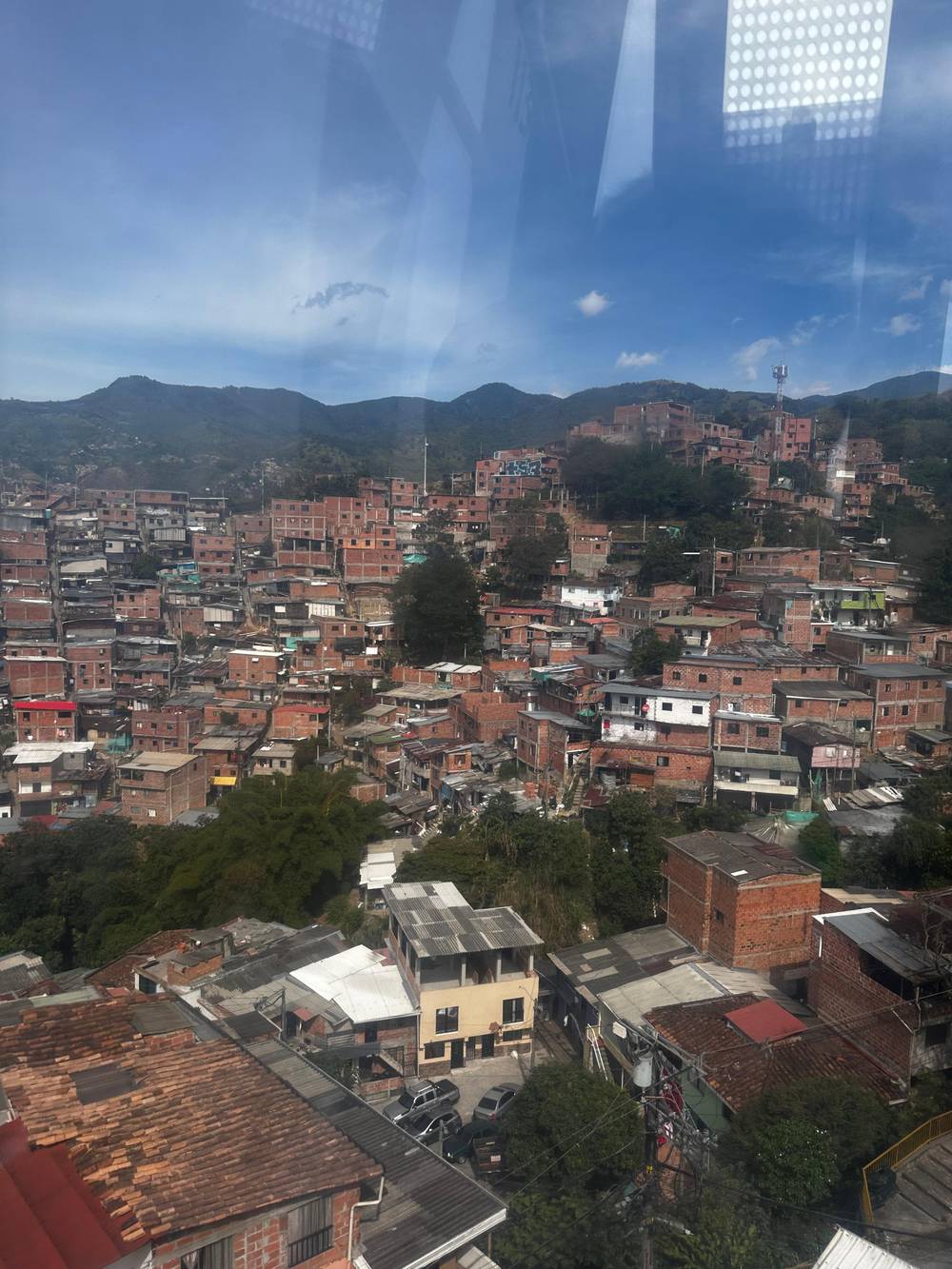
If you ask what is Comuna 13 in Medellin, the short answer is a city district that doubles as a cluster of hillside neighborhoods with a story of its own. Medellin.travel, the city's visitor guide, uses the other name San Javier and counts the district among the 16 comunas that make up Medellin.6 The same guide measures it at 74 square kilometers, with more than 18 neighborhoods inside.7 Visitors who say La Comuna usually mean the stretch they walk, around Las Independencias.
The National Center for Historical Memory, a Colombian public body, describes the district a little differently, as a set of 19 barrios anchored in the mountains of central-west Medellin.1 The count differs from the visitor guide's, and that is a normal feature of administrative maps, where neighborhoods are divided and renamed. What both descriptions share is the picture of a steep, densely settled slope, far from the center in distance and, for a long time, in services.
The memory center explains how the slope filled up. Its report says the settlement of the commune came from migration patterns known in other regions of Colombia, from social and economic exclusion, and from forced displacement caused by war in recent decades.1 That origin matters for a visitor, because it means many families on these streets arrived with little and built what they had. When a guide tells you a story, you are often hearing a family history.
Dates from the sources
| When | What | Source |
|---|---|---|
| May 2002 | Operation Mariscal is decided8 | Memory center report |
| 16 October 2002 | Operation Orion begins2 | Memory center report |
| 2004 | Revolucion Sin Muertos festival starts16 | Memory center document |
| 2006 | Large infrastructure works begin4 | ProColombia |
| 2008 | A cable car links the commune10 | ProColombia |
| 2011 | The escalators open11 | ProColombia |
Dates are as each source states them. The memory center's report and the city's press page do not always use the same totals, and the page says whose count is shown.15
Official tourism writing does not avoid the hard part. ProColombia's travel site describes Comuna 13 in the 1980s and 90s as the center of trouble in a city then ranked among the most dangerous in the world, and as cut off from the rest of Medellin by its hillside position.14 That is a short sentence for a long period, and no short sentence can hold the experience of the people who lived through it. Treat it as a pointer to the context, not as a summary.
The memory center's report gives more detail on why the commune became a place of conflict. It describes the social and economic exclusion of the district, together with a weak presence of the state and its institutions, as the setting in which several armed actors operated.1 The report was written to explain forced displacement inside the city, and it treats Comuna 13 as a case that shows how war reached a large urban area.
None of this is the face you meet today, but it is the reason the place is of interest to visitors who care about history. A page like this cannot do justice to the long years before the escalators, the cable car and the murals. If you want that depth, the best sources are the residents who choose to tell their stories on a walking tour, and the public memory institutions that have collected testimonies.
Counts, with attribution
These are the counts the city government attributes to the National Center for Historical Memory, the Truth Commission and Corporacion Juridica Libertad for Operation Orion. They are not a complete record.15
In 2002 the district became the setting of a series of military operations.8 The memory center's report says that in May 2002, after 6 military operations between February and May, a larger operation named Mariscal was decided, which the public force said aimed to stop a supposed plan to sabotage the elections.8 The report says Mariscal and Operation Orion were actions without precedent in Colombian cities, and that they made Comuna 13 visible to the whole city as the setting of what was then called the urbanization of war.21
Operation Orion is the operation most people mean when they speak of that year. The memory center's report says it began on 16 October 2002 and was the largest armed action in an urban territory in the armed conflict in Colombia.2 The city government describes it the same way, as the largest urban military incursion in Colombia, carried out from 16 to 18 October 2002 by army soldiers and police in Comuna 13.22 The report adds that about 1,500 personnel took part.9
Residents lived through those days at home. The report says the cordon lasted several days, blocking transport, leaving shops short of food and limiting access to health services.23 It adds that Operation Orion is inscribed in the memory of Comuna 13's residents as an indelible mark of the war that reached their neighborhoods.24 Those are the report's words, and they are a good reason to approach the subject quietly on a visit.
Where to go deeper
Choose the angle you care about and the matching step follows.
If I want the official record
The memory center report
The report treats displacement in the commune in detail.1
If I want the residents' voices
A guided walk with a local
Local voices carry the story, and the city guide recommends them.17
If I want music and memory
Hip hop and the Kolacho School
Hip hop became the axis of youth identity in the commune.3
If I want the video and art
The Casa de la Memoria film
The city co-produced a 5 chapter documentary with victims.18
If I want a gentle start
The viewpoint and the stairs
The viewpoint above the stairs shows the commune from above.19
Chapters
Context
A slope settled by need
See the tours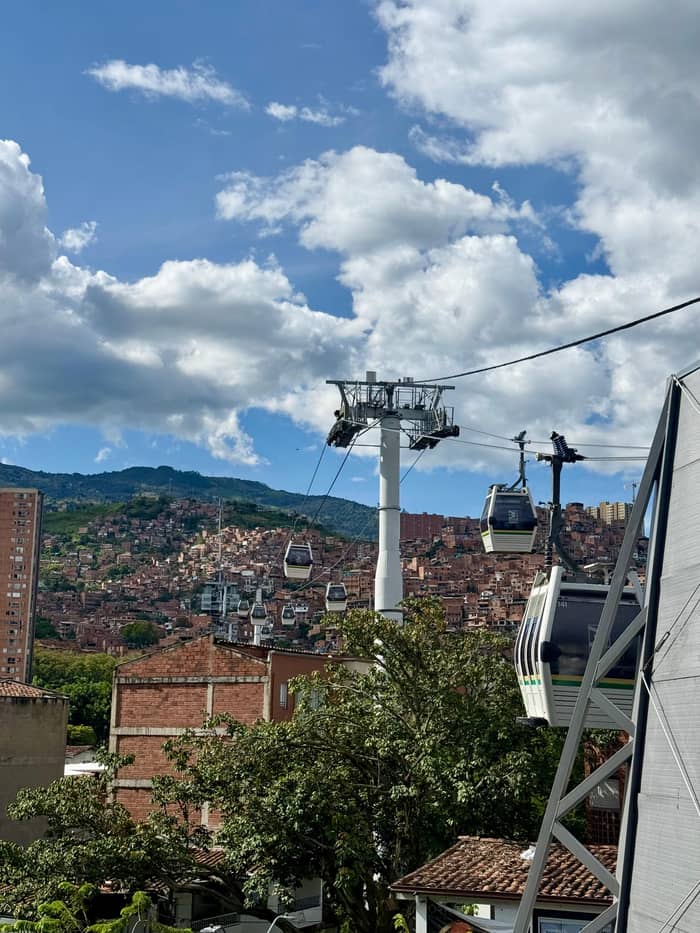
Conflict
Mariscal and Orion
See the toursToday
What residents built
See the toursNumbers about Orion differ between sources and between dates, which is common after events that were contested for years. The city government's page on the documentary made years later gives figures it attributes to the National Center for Historical Memory, the Truth Commission and Corporacion Juridica Libertad: 17 people executed by the public force, 71 by paramilitaries, 92 disappeared, 12 tortured and 80 injured.15 The chart on this page shows exactly those counts, with the same attribution.
A visitor should not treat any single total as final. The same city page notes that the operation caused displacement inside the city and left civilians in crossfire,15 and the memory center's report was written specifically about forced displacement in the commune. Where you meet a number on a tour, a good question is who counted it and when, and a good guide will be glad to be asked.
The memory center's report also looks at what followed. It cites a study finding that homicidal violence in Comuna 13 fell by 81 percent in 2003 to 2006 compared with 1999 to 2002, and it adds that displacement continued under paramilitary control in those years.27 That is the complicated truth of the period: a fall in a measure, and continued suffering in another. Official memory sources keep both facts in the same paragraph, and so should visitors.
A sequence
Earlier years
Exclusion and displacement shaped the slope.1
May 2002
A larger operation follows 6 earlier ones.8
October 2002
2006 to 2011
Later years
Local artists paint the neighborhood.12
Today
The guide advises an open mind.13
Part of the answer came as music. In a National Center for Historical Memory document about the group C15, hip hop is called the guiding axis of youth identity and expression in Comuna 13, and training spaces such as the Kolacho Hip Hop School are named.3 That document says the school was founded after the murder of the MC Kolacho and carries the name of a friend and former leader of the group.28 Hip hop here is a way of remembering as much as a style.
The festival Revolucion Sin Muertos belongs to the same story. According to the memory center, it has run since 2004 as a protest against violence and, after 8 years, ranked as the second most important hip hop festival in Colombia.16 The same text says the La Elite Hip Hop network dates from 2002.29 ProColombia's Graffiti Tour page meets young people who changed their lives through graffiti, hip hop and theater and names groups like Kasa Kolacho.30
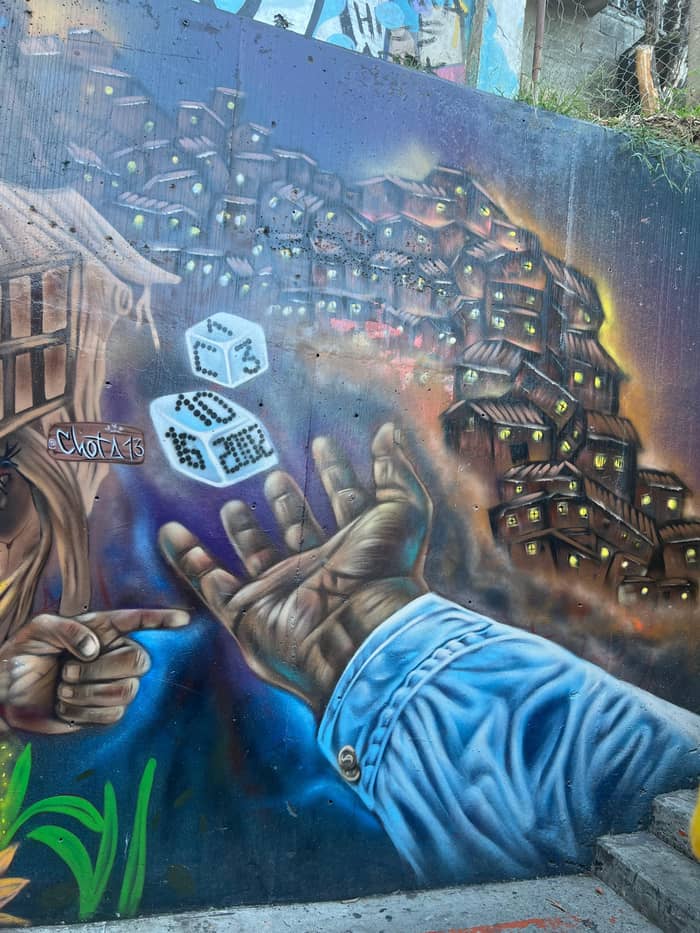
Institutions keep the memory work going. Years after Orion, the city government co-produced a documentary with victims, the Museo Casa de la Memoria and the Secretariat of Non-Violence, in 5 chapters that use artworks and artistic representations to show effects on civil society, nature, women and childhood.18 The city also says murals and artistic expression helped shift the negative image of Comuna 13, a stigma it bore for many years.31
Video
Tay International on YouTube · Nothing is fetched until you hit play.
Remember, people live here, so your visit should encourage coexistence and cultural exchange, not feel intrusive.
The physical change came through public works. ProColombia's account says the mayor of Medellin led the transformation of Comuna 13 with large infrastructure investments starting in 2006, aiming to integrate the cut-off neighborhoods and reduce crime, not to attract tourists.4 A cable car built in 2008 linked residents to the rest of the city, and in 2011 came a series of covered outdoor escalators that saved residents from climbing roughly 350 steep steps.10,11
Art and visitors followed. When the escalators were finished, the city invited local artists to cover the neighborhood in art and graffiti as a celebration,12 and residents began running galleries, cafes, souvenir shops, book shops and fruit stands from their own homes.32 ProColombia's account says Comuna 13 now welcomes tens of thousands of visitors each week, and it adds that living costs have risen and privacy has gone down.33,34 The city press office quotes a community leader on the same loss of privacy.35
Today the official guide calls La Comuna 13 in Medellin a safe, welcoming space for respectful visitors, despite a history of violence.5 The city's report on the Graffitour says its aim is to tell a story of overcoming and resistance while pointing to many positive things about a popular neighborhood of Medellin.36 The city also acknowledges that challenges remain and that lasting change needs continued attention.37 Both statements can be true at once.
Because the history is recent, your behavior is part of the visit. People live here, Medellin.travel reminds readers, so a visit should foster coexistence and cultural exchange rather than feel intrusive.20 The guide steers visitors toward local guides, who it says know the area's history best,17 and asks for an open mind.13 The city's leaflet condenses this to a line: go without prejudice and respect the residents.25
On a walking tour, you will hear stories that are not in any brochure. Listen first and ask questions after, and let the guide decide how much to tell. The city's own report presents the Graffitour as a story of overcoming, and many residents are glad to talk about the change they have seen.36 If a guide says a subject is too painful to discuss, accept that. Never ask residents to pose for photographs about the violence.
Support the people who keep the place running. Medellin.travel asks visitors to buy local products, a purchase that helps the community and its development.26 A snack, a drink or a handmade souvenir from a local stall says thank you more directly than any review. The walks in the calculator pair history with local food; read their itineraries and pick the pace that suits you, and keep the conversation going with your guide.
FAQ
The Museo Casa de la Memoria co-produced a documentary with victims and the city, in 5 chapters.18
The memory center says it was created after the murder of the MC Kolacho and is named in his honor.28
Sources
Next read
Planning a walk through the murals? Ask a real person here.