
By bus
Metro and bus
The everyday route
See the toursGuides
Language
Currency
View availabilityfrom $21 · no cancel feePick out your stop
View 15 stops
First pick a route, then tap any pin or stop for details and Google Maps.
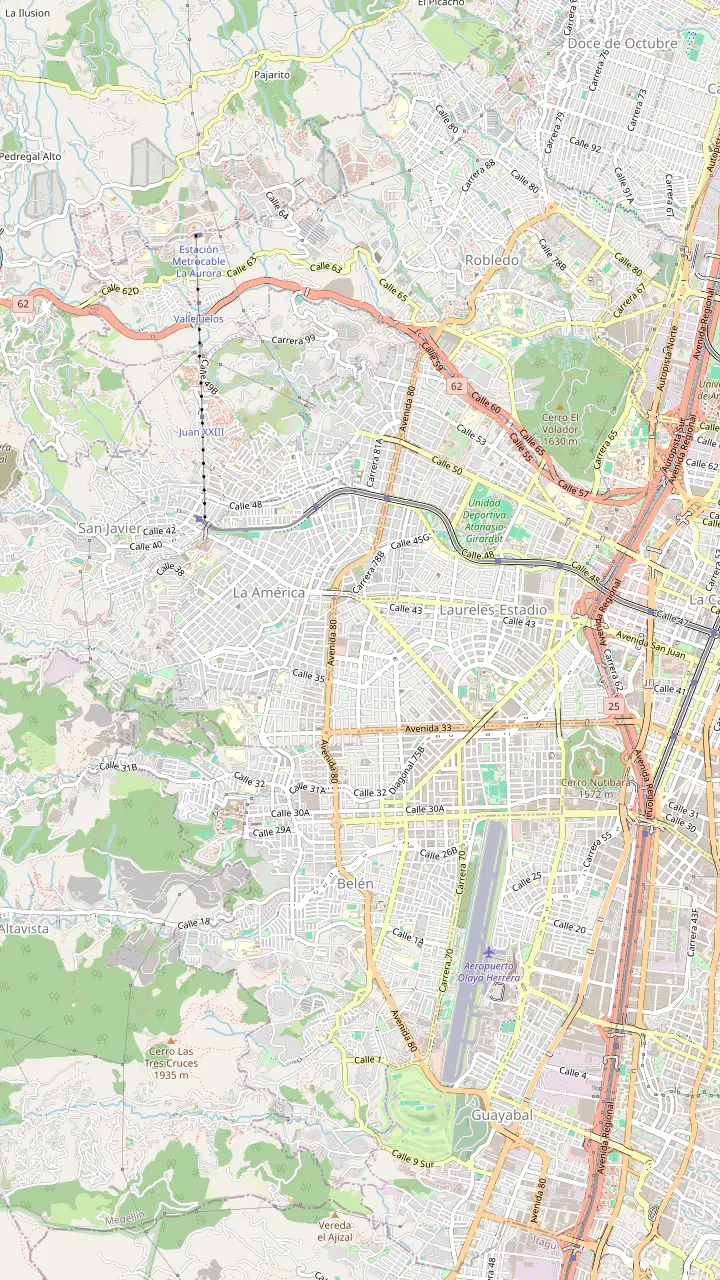
El Poblado is where the home tour starts, with 2 starting locations and a metro ride before the cable car.
Google MapsSan Javier is the last stop on Line B heading west and the nearest metro station to Comuna 13.
Google MapsLa Aurora is the far end of Metrocable Line J, which leaves from San Javier with panoramic views of the commune and the city.
Google MapsThe escalators stand in the Las Independencias neighborhood, with the viewpoint at the top reached by the first public escalators.
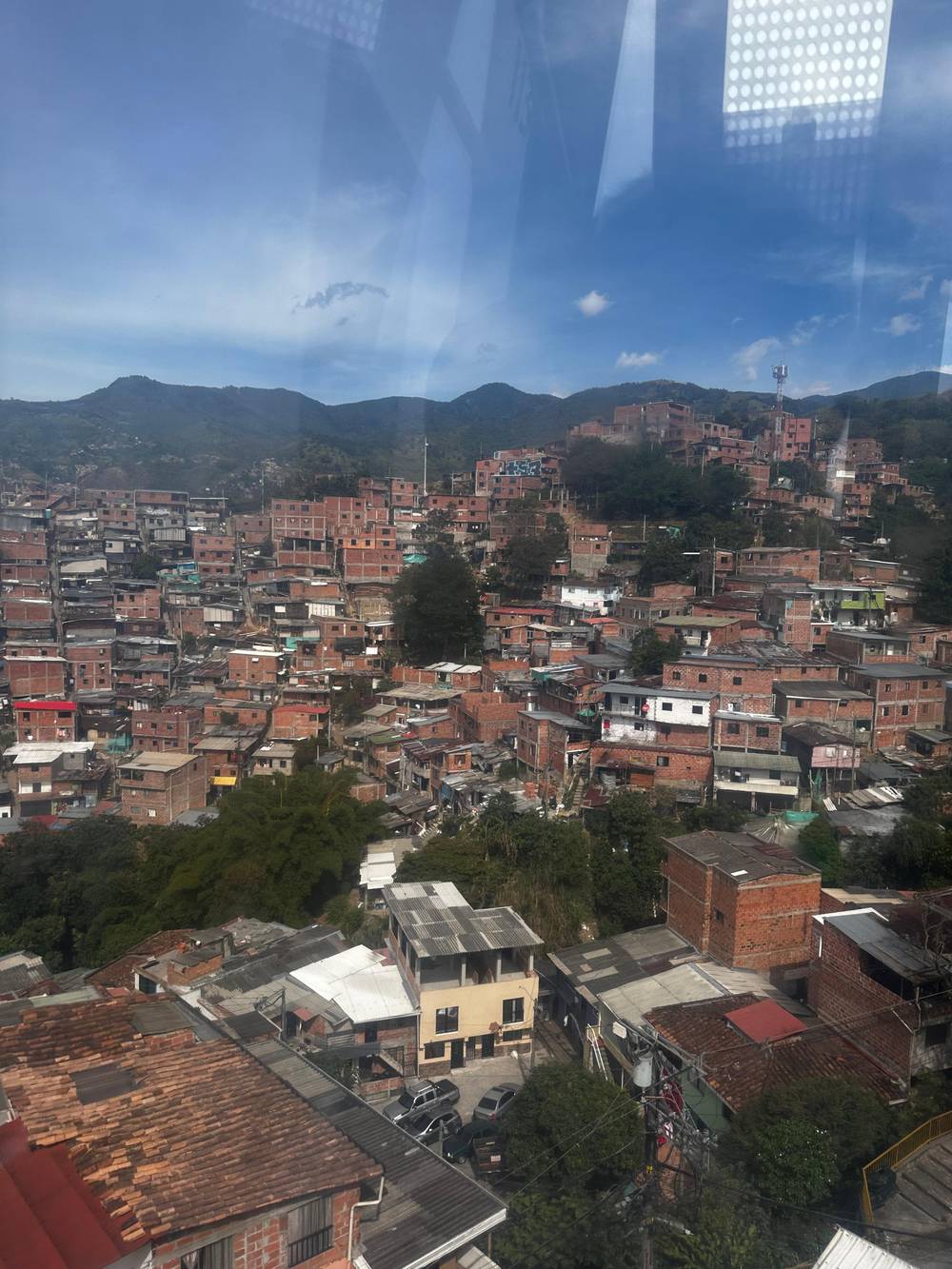
Google MapsThe viewpoint above the escalators shows brightly colored houses against the mountains of Medellin.
Google Maps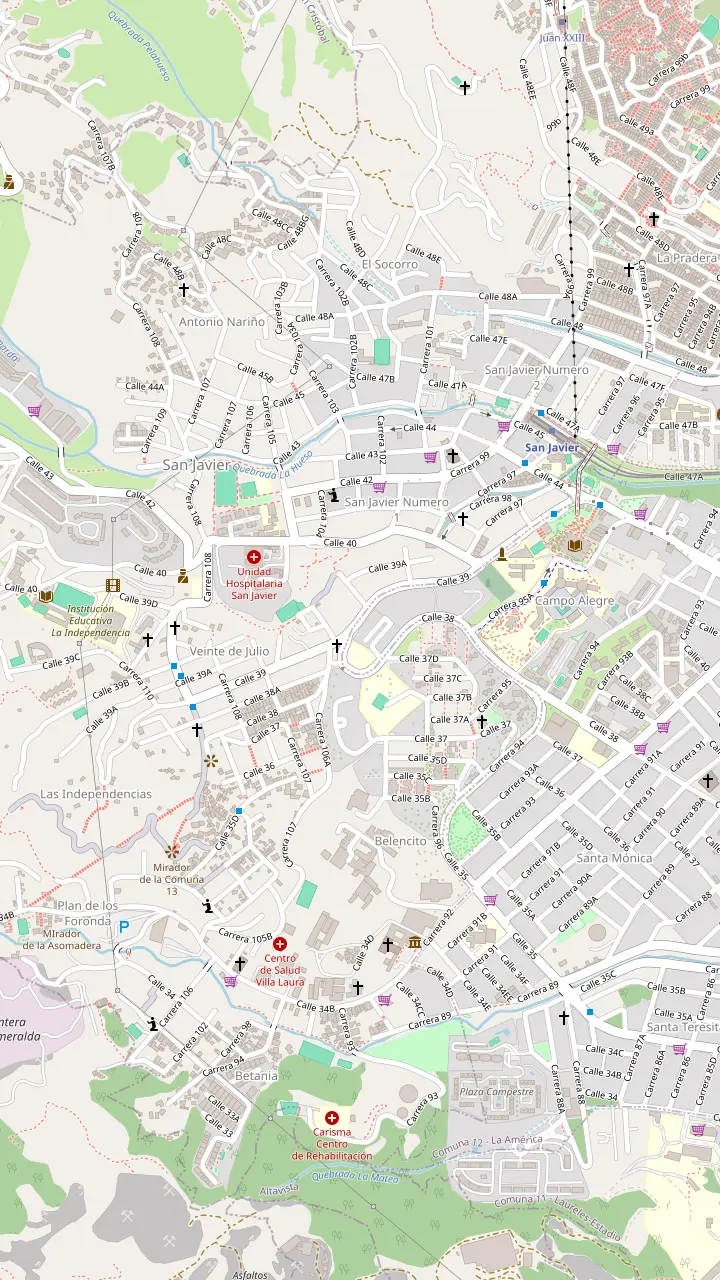
San Javier is the last stop on Line B heading west and the nearest metro station to Comuna 13.
Google MapsThe escalators stand in the Las Independencias neighborhood, with the viewpoint at the top reached by the first public escalators.
Google MapsThe viewpoint above the escalators shows brightly colored houses against the mountains of Medellin.
Google MapsSan Javier is the last stop on Line B heading west and the nearest metro station to Comuna 13.
Google MapsThe escalators stand in the Las Independencias neighborhood, with the viewpoint at the top reached by the first public escalators.
Google MapsThe viewpoint above the escalators shows brightly colored houses against the mountains of Medellin.
Google Maps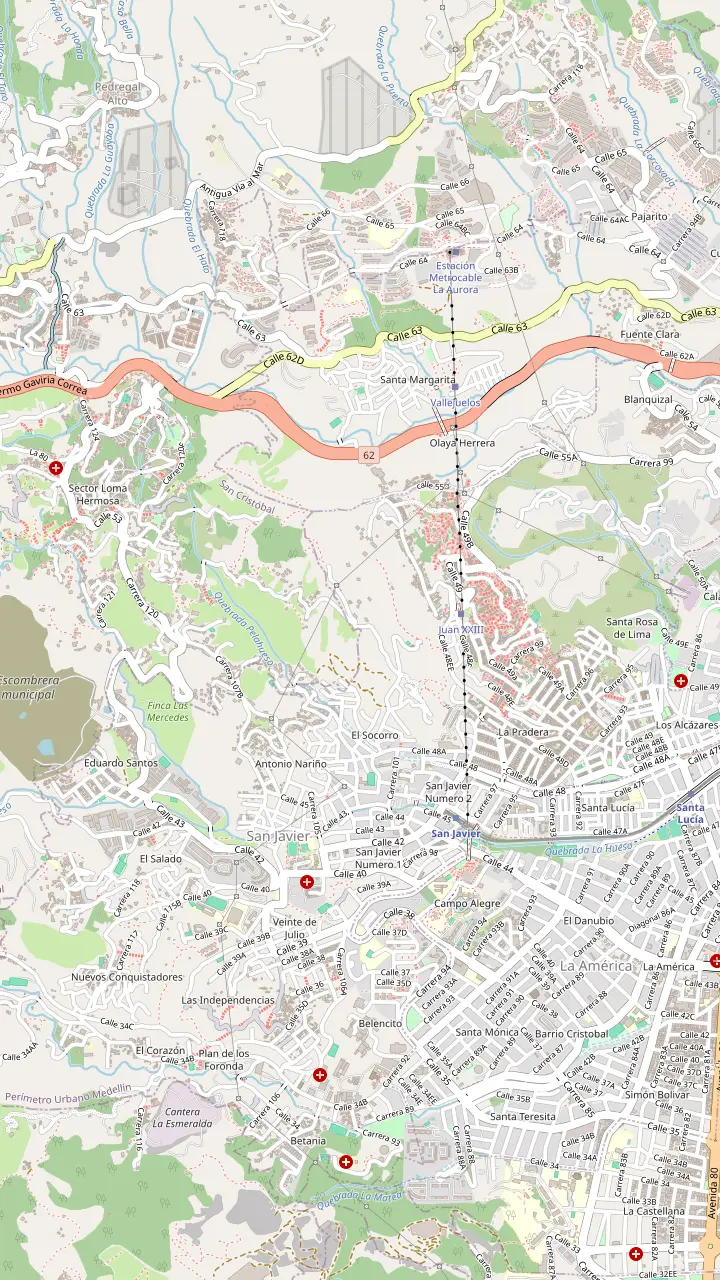
La Aurora is the far end of Metrocable Line J, which leaves from San Javier with panoramic views of the commune and the city.
Google MapsSan Javier is the last stop on Line B heading west and the nearest metro station to Comuna 13.
Google MapsThe escalators stand in the Las Independencias neighborhood, with the viewpoint at the top reached by the first public escalators.
Google MapsThe viewpoint above the escalators shows brightly colored houses against the mountains of Medellin.
Google MapsMap source: © OpenStreetMap contributors
The covered outdoor stairs that changed daily life in Las Independencias, where they stand, what the city says about them and the easiest way up from San Javier.
Editorial team, comuna13tour.click · Updated November 24, 2026 · Takes 8 min
Overview
The Comuna 13 escalators in Medellin are covered moving stairs set outdoors on a steep hillside in the west of the city. Medellin.travel, the city's own visitor guide, uses the other name for the district, San Javier, and counts it among the 16 comunas of Medellin.8 The city places the stairs in the neighborhood of Las Independencias, and its leaflet gives the address as carrera 110 number 34CC-115.1 Give that address to a taxi driver if you must, though public transport gets you there more easily.
What makes the place memorable is not only the machinery. At the top the city guide describes a viewpoint, reached on the neighborhood's first public escalators, where brightly colored houses sit against the mountains around Medellin.2 A second page of the same guide goes further and credits Comuna 13 with the first public escalators in the country.9 Treat that as the city's own description, and enjoy the view for what it is: a hillside of houses stacked up the slope.
Locals call the system escaleras electricas, and anyone searching in Spanish for escaleras comuna 13 Medellin lands on the same stairs. They are part of daily life for the people who live beside them, which shapes how a visitor should act. Medellin.travel makes the point directly: people live here, and a visit ought to make for coexistence and cultural exchange, never an intrusion.10 Greet people, keep your voice down on the landings and treat the stairs as a shared street.
Figures with sources
| What | Figure | Where it comes from |
|---|---|---|
| Stages | 6 stages4 | City maintenance notice |
| Neighborhood | Las Independencias1 | City leaflet |
| Start of operation | May 20113 | City release |
| Steps replaced | 200 to 380 per trip3 | City release |
| Residents served | More than 12,00018 | City notice |
| Lights replaced | 18019 | City maintenance notice |
| Solar panels | 56, installed 202213 | City release |
| New viaduct stretch | 102 m15 | City works report |
Figures are as the city published them, in releases of different dates, so a number can differ between pages. Where releases disagree, the page gives both.13,20
The city describes the system as 6 stages, which it calls tramos, and its maintenance notices treat them as separate machines.4 A notice about repairs explains that stage 3 runs downward and stage 4 runs upward, which tells you the stairs are not a single continuous escalator.5 In practice you ride a stage, step off onto a landing, and walk or turn to the next. Between stages the street continues, and the street is where the neighborhood happens.
These are the outdoor escalators of Comuna 13 in Medellin, and the stages sit inside a lived-in slope. Houses press against the landings, and the roofs below are often painted. ProColombia's urban art feature adds that the view down toward the foot of the line shows roofs doing duty as canvases.16 Stop on a landing and look back down the line before you ride on, since the view changes with every stage you climb.
Moving stairs wear out when many people use them. In a repair notice the city reported more than 715,000 visitors in December and January, a flow that cracked and wore a belt on stage 3.14 The fix was a new belt and a clean of the mechanism. For you, the practical lesson is simple: a stage can be closed for repair on the day you come, so look at the whole stairway and walk the street beside it if a section is stopped.
Before the escalators, getting home meant climbing. The city's own account says residents faced difficulty moving along steep streets and endless stairs, which limited access to essential services and economic opportunities and added to physical and social isolation.27 A city release puts a number on the climb, saying daily trips meant 200 to 380 irregular steps per trip.3 ProColombia's travel site gives a rounder figure of roughly 350 steep steps.17 The sources differ, so take the range and not any single number.
The stairs were meant for residents first. The city says they let people reach schools, jobs, health services and daily activities more efficiently,28 and in a later release it says the system improves mobility and quality of life for more than 12,000 people in the area.18 ProColombia's account places the escalators in a wider program that started with large infrastructure investments in 2006, aimed at joining cut-off neighborhoods to the city and reducing crime and not at attracting tourists.11
Tourism came afterward. According to ProColombia, the completed escalators were celebrated with an invitation to local artists to paint the neighborhood,29 and residents then opened galleries, souvenir shops, cafes and fruit stands in their own homes.30 That account also admits a cost: living costs have risen and privacy has fallen.31 Hold both sides of the story in mind as you ride up.
Pick your route
Pick the result you want and the route that delivers it appears.
If I want the quickest way from the metro
Bus 221i or 225i
The buses leave from the station exit and drop riders near the stairs.7
If I want a view of the whole commune
Metrocable Line J
Line J out of San Javier gives wide views over the commune and city.21
If I want the story, not just the stairs
A guided walk
The city guide advises a local guide, who knows the story of the area.23
If I want to avoid a long climb in the heat
Go with sunscreen and water
The guide advises sunscreen and carrying water for the steep streets.24,25
If I want to take photographs from the top
The viewpoint above the stairs
At the top the guide promises a panorama of the whole city.26
Ways up
By bus
The everyday route
See the tours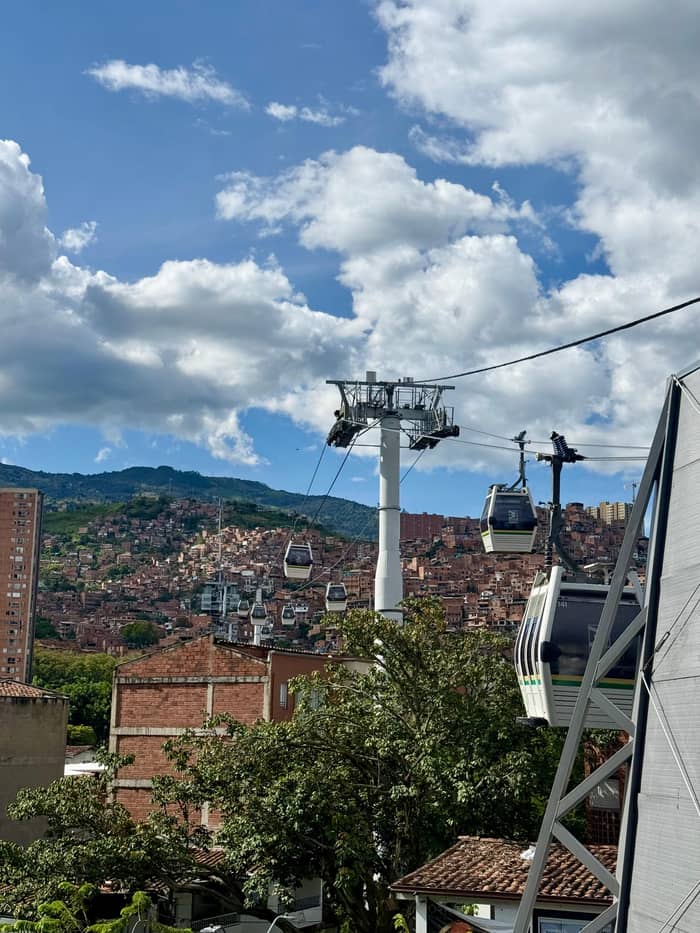
By cable car
The scenic route
See the toursWith a guide
Stairs plus the story
The simplest route starts on the metro. Medellin.travel points to San Javier, where Line B ends in the west, as the nearest station, with a change at San Antonio when you come from Line A.6 The city's own escalator leaflet agrees on San Javier and adds that you can continue by taxi or by buses 221i or 225i.34 Metro de Medellin's Line J page also lists the escalators under the integrated route 221i.35
The buses are easy to find. According to Medellin.travel, routes 221i and 225i depart from a stop on the right of the station exit and leave riders two blocks from the escalators.7 Tell the driver your destination so you are called at the right stop. Walking is possible too, but the streets climb steadily, a fair preview of what the stairs were built to solve, so allow time and wear shoes you trust.
The Metrocable is the scenic alternative. Line J leaves San Javier station and, per the city guide, gives panoramic views over the commune and the whole city.21 The guide suggests opening or closing a visit with the ride, with a caution that looking from above cannot capture the neighborhood or the Graffitour on foot.22 Use the cable car for the overview, then come down to the street for the part that matters.
Tours that use the stairs
Set the size of your group and weigh tours that climb the stairs.
Compare 3 alternatives
Set the size of your group and weigh tours that climb the stairs.
≈
View≈
View≈
ViewCurrency conversion uses the ECB reference rate on GetYourGuide from-prices. The exact price is displayed when you book.
From climb to landmark
2006
The mayor leads large infrastructure investments.11
2008
The link saves residents commuting time.12
May 2011
The city dates the start of service to May 2011.3
2022
56 panels replace part of the electricity used.13
December and January
More than 715,000 visitors, per the city.14
Later
A new 102 m stretch of viaduct joins the route.15
A visit to the escalators is mostly walking. For shoes, Medellin.travel recommends sneakers or boots for the steep streets and stairs that many tours climb.32 It also suggests sunscreen even under cloud, a light sweater or jacket against cooler afternoon winds and an umbrella for rain.24 Pack a small bag, keep your phone in hand only when you need it, and leave a hand free for the rail.
Bring water. Per the city guide, bottled water is on sale at local shops if you did not pack your own, and trash should be disposed of responsibly.25 Buying from those shops also supports people who live beside the stairs, which Medellin.travel asks of visitors through local purchases.33 A cold drink after the climb is a fair trade for a few minutes of someone's time, and a chat at the counter often tells you more about the neighborhood than a sign would.
Photographs come naturally here. At the top of the stairs Medellin.travel promises a fantastic panorama of the city, and suggests you carry a camera with generous storage.26 Do not be surprised if a friendly local guide or fellow traveler offers to photograph you.36 Say yes if it feels right, and ask before you photograph anyone else. Residents have their own view: a community leader told the city press office that many felt they lost privacy and calm once tourists began to pass.37
Video
Chimba RAW on YouTube · Nothing is fetched until you hit play.
accessible via the neighborhood’s first public escalators, designed to improve mobility for residents.
Before you ride
Terminales Medellin operates and administers the escalator system for the city, and a maintenance notice shows what that involves.38 In a 15 day preventive maintenance, the operator used the provisional suspension to replace 180 lights, along with a thorough cleaning of the roofs over the 6 stages.19,4 When the system stops for work, the notice is the thing to look for, because the sources I could read do not publish daily hours, so check before you plan around a fixed time.
The stairs also run partly on sun. In 2022 the city put 56 solar panels into service, replacing 21 percent of the electricity used for the escalators and their lights.13 A later release says the panels installed in 2022 replace 35 percent of the energy used by the whole project.20 The percentages come from different releases and different scopes, so quote each with its date. Either way, the roofs you walk under are part of an energy plan.
The corridor beside the stairs is growing. A city works report describes a new 102 m stretch of the Media Ladera viaduct that extends the pedestrian corridor of the graffitour,15 and adds 1,655 square meters of public space with viewpoints and seating areas.39 By the city's count, more than 160,000 people in Las Independencias I, II and III gain direct access to the escalators.40 Expect the route to look different from older photographs.
A guided walk turns the escalators into a story. The city's report on the Graffitour places the meeting point at carrera 109 and calle 38 A in the 20 de Julio neighborhood, then follows a route past terraces and mural stories, over 6 escalator stages, and on to art shows and street food.41,42 Its guide started the Graffitour after working from 2013 as an operator of the escalator project.43 A guide who once operated the stairs knows how they work from the inside.
Tours spend different amounts of time on the stairs. The 3 hour snacks tour from $14 lists riding the outdoor escalators among its highlights, alongside guided walking and arts and crafts markets. The 4 hour district tour from $21 puts a metro ride and 40 minutes in the cable car ahead of a guided walk of 80 minutes in Comuna 13. These are listing labels, so read each itinerary before booking.
This site's own tour is a small group capped at 10 over 4 hours, with a metro ride, a cable car, coffee, a dance show, street food and a 1.5 hour guided tour. Prices start from $20 and are from-prices, not quotes. Whichever you choose, the escalators are the hinge of the day, the place where a residents' commute turned into a walk that visitors now come to see, and the top of the stairs is where that change becomes easy to read.
FAQ
Medellin.travel calls the stairs public and free, the first of their kind in the country, and none of the sources we read names a fare.44
The city says residents faced steep streets and endless stairs that limited access to services and opportunities.27
The city says Terminales Medellin operates and administers the system.38
Sources
Next read
Planning a walk through the murals? Ask a real person here.